Home / Storybooks / The Broom That Swept Backward
The Broom That Swept Backward
A Story Of Hearth Magic
The Broom That Swept Backward
A Story Of Hearth Magic
A Salem Witch Shop storybook
1The broom had belonged to Hattie's great-grandmother Ada, and it was older than the house it lived in.
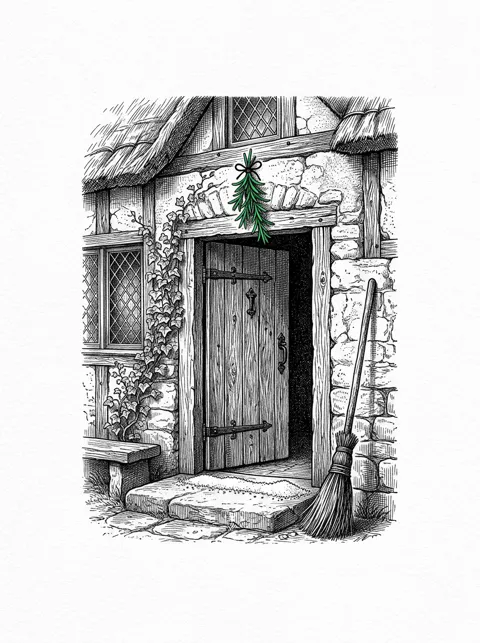
It had a handle of dark ash wood worn smooth where hands had held it, and a head of birch twigs bound with copper wire. It stood behind the kitchen door with its bristles up, the way Ada had always kept it. Mom said that was so the luck wouldn't run out of it. Dad said it was so the bristles wouldn't bend.
Hattie Corliss, who was ten and the youngest, liked it because it smelled like a campfire that had happened a long time ago.
The first morning it swept backward, nobody noticed but her.
2Mom was sweeping the kitchen before work, the way she always did, in long pulls toward the back door. Hattie sat on the step stool with her cereal and watched the dust go out over the threshold in a little gray cloud.
Then the cloud stopped.
It hung in the doorway for a moment, as if it had forgotten something. And then it drifted back in. It rolled across the linoleum against the direction of the broom, curled around Mom's sneakers, and settled itself neatly in the corner by the stove.
Mom didn't look up. She was frowning at her phone with her other hand.
"Mom," Hattie said.
"Not now, Hat. Your father moved the car keys again."
3That was how things were in the house that fall.
Dad had lost his job at the boatyard in August, when the yard was sold to a company from somewhere inland. Now he was home all day, fixing things that weren't broken. Mom worked double shifts at the clinic. And Hattie's brother Gideon, who was fifteen, had stopped talking to Dad at all after the night of the shouting.
The house felt like a held breath. Doors closed a little too hard. The radiator ticked.
And every morning, the dust came back in.
Hattie started sweeping herself, to test it. Out the door the dust went. Back in it came, every time, like a dog that wouldn't stay outside.
4There was only one person who would have known what to do, and she had been gone for thirty years. So Hattie went to Ada's recipe box.
It sat on top of the refrigerator next to the coffee can, a tin box painted with faded strawberries. Most of the cards were for chowder and brown bread. But tucked in the back were cards written in pencil, in Ada's small slanting hand, that were not recipes for food.
Salt across the door sill keeps out what is not welcome, said one.
Rosemary over the door, for a house that is kind to itself, said another.
Never sweep after dark, or you sweep the luck out.
Broom by the door, head up. If it misbehaves, ask what the house wants.
5Hattie started with the salt, because it seemed the simplest.
That night after supper she took the round blue canister from the cupboard and knelt at the back door. She poured a thin white line along the sill, end to end, with no gaps, the way the card said. Then she did the front door too. The salt glittered on the dark wood like frost.
Gideon stepped over it on his way out to the porch and didn't say anything. Dad nearly stepped in it, stopped, and looked down.
"Ada used to do that," he said. His voice sounded strange. "Every fall."
Then he went upstairs, and the bedroom door closed a little too hard.
In the morning the salt line was perfect. Not a grain had moved. And the dust came back in anyway.
6So it wasn't something outside, Hattie thought. The salt would have stopped something outside.
She tried the rosemary next. There was a scraggly bush of it by the mailbox that nobody had planted on purpose. She cut a sprig with Mom's kitchen scissors, tied it with a bit of red thread, and stood on a chair to tuck it over the back door, on top of the frame where the paint had cracked.
The kitchen smelled green and sharp, like pine needles and pepper.
For a whole day the house was quieter. Dad made grilled cheese. Gideon ate two. Mom came home and sat at the table and laughed at something on the radio, and Hattie thought, There. That's done.
That night she woke to the sound of sweeping.
7It was past midnight. The hall light was off. Hattie crept down the stairs in her socks, keeping to the edges where the steps didn't creak.
The kitchen was full of moonlight and the smell of rosemary. The back door was shut and locked.
And the broom was moving.
Nobody held it. It stood upright in the middle of the floor and swept, slow and steady, in long pulls toward the inside of the house. Dust rose from nowhere. It came from under the door, from the cracks between the floorboards, from the dark beneath the stove. The broom gathered all of it into a small gray pile in the very center of the kitchen, right under the lamp that hung over the table.
Then it stopped, and leaned itself back behind the door, bristles up.
8Hattie stood looking at the pile for a long time.
It was not ordinary dust. When she crouched close, she could see things in it. A button. A bent bobby pin. A folded square of paper. Ada's card had said to ask what the house wanted, and the house was not asking for anything to be kept out. It was putting something in the middle of the table, where everyone would have to look at it.
She picked up the paper and unfolded it.
It was her own permission slip for the class trip to the aquarium. Across the bottom, in the school secretary's red stamp, was the word PAID.
Hattie's stomach went cold and tight. She looked up at the coffee can on top of the refrigerator.
9It had been the second week of school. The trip cost twenty dollars, and Hattie had heard Mom and Dad at the kitchen table at night, talking about money in the low voices people use when they think the walls are thicker than they are.
So she hadn't asked. She had climbed on a chair while everyone was out and taken one bill from the coffee can, where Dad kept what was left of his last paycheck from the boatyard. She had meant to pay it back. She didn't know how.
Three days later Dad had counted the can.
And Gideon, who had been out late twice that week, was the one Dad shouted at. Gideon said he didn't take it. Dad said, Then who did. And Hattie had stood at the top of the stairs and said nothing.
10She sat down on the cold kitchen floor beside the pile of dust.
The salt was still on the sill. The rosemary was still over the door. They were doing their work. Nothing bad was getting in. The bad thing had never been outside.
Ada's card said a house that is kind to itself. Hattie understood now that a house couldn't be kind to itself if the people in it kept something sharp hidden in their pockets.
She thought about not telling. She could sweep up the pile herself before anyone woke. She could throw the slip away. But the broom would only sweep it back. She knew that. It would sweep it back every night until somebody said it out loud.
She left the pile where it was and went to sit on the stairs and wait for morning.
11Dad came down first, at six, the way he always did now, because he had nowhere to be and couldn't stand to lie in bed. He stopped in the kitchen doorway and stared at the gray pile under the lamp.
"What on earth," he said.
Then Gideon came down behind Hattie, rubbing his eyes. Then Mom, in her scrubs.
Hattie stood up. Her knees were shaking. She held out the pink slip so they could all see the red stamp.
"I took the twenty dollars," she said. "For the aquarium. It wasn't Gideon. I heard you yelling and I didn't say anything, and I'm sorry, and I'll pay it back. I'll do anything."
Her voice cracked on the last word. Nobody moved.
12Hattie waited for the shouting. It felt like she had been waiting for it for a month.
It didn't come.
Dad sat down very slowly at the kitchen table. He looked at the slip, and then at Gideon, and his face changed in a way Hattie had never seen it change before.
"I called you a thief," he said to Gideon. "In front of your sister."
Gideon shrugged with one shoulder, the way he did when something hurt. "You were scared about the money."
"That's not a reason."
"No," Gideon said. "But it's why."
Mom put her hand on the back of Dad's neck. For a while nobody said anything. The radiator ticked. Then Dad held out his arm, and Gideon came, and after a second so did Hattie.
13Hattie paid the twenty dollars back by raking Mrs. Osgood's leaves next door every Saturday in October. Gideon helped on two of them without being asked. Dad started building lobster traps in the garage for a man down at the harbor, and slowly the coffee can filled again.
The morning after she told, Mom swept the kitchen the way she always did, in long pulls toward the back door.
The dust went out over the threshold in a little gray cloud. It hung there in the sunlight for a moment, above the line of salt, under the sprig of rosemary that had dried brown and sweet.
Then the wind took it down the steps and across the yard, and it did not come back.
14The Real Practice Behind The Story
Brooms, salt and herbs turn up in house protection customs across Europe and New England. Many households kept the broom by the door with its bristles up, and old sayings warn against sweeping after dark or sweeping dirt across someone's feet. A line of salt along a doorsill is a widespread folk charm against unwelcome things, and rosemary hung over a door was said to guard a house and keep the people inside on good terms. Hearth magic, the old name for the small rituals of keeping a home, is mostly ordinary work done with care. Sweeping, cooking, mending and settling quarrels all belonged to it.
15The End
Next on the shelf is The Girl Who Bottled the Wind.
Open The Next BookBack To The Shop16
Where Our Name Comes From
Salem, Massachusetts, where most of the town's witch shops sit on or near the Essex Street pedestrian mall. We are an online shop, not a storefront there.