Home / Storybooks / The Drawer With No Bottom
The Drawer With No Bottom
A Story Of Herb Magic
The Drawer With No Bottom
A Story Of Herb Magic
A Salem Witch Shop storybook
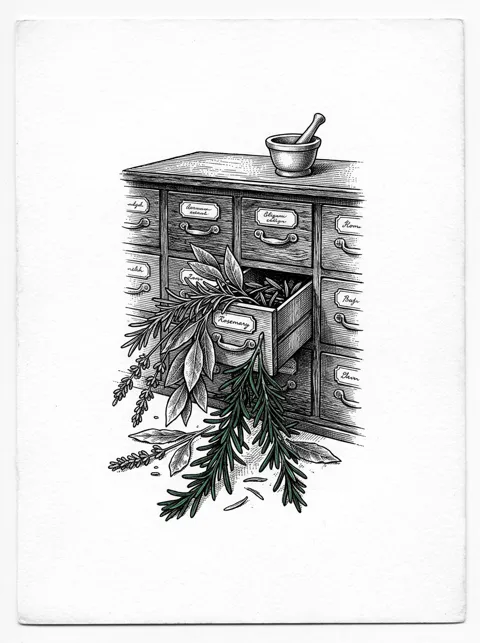
1The cabinet in the back of the shop had forty-two drawers, and Marisol had counted them on her first day.
Each drawer had a brass pull shaped like a curled leaf and a paper label written in brown ink in Mrs. Hollin's slanted hand. Yarrow. Mint. Elder. Thyme. When you pulled one open, the smell came out to meet you, green or sharp or sweet, and the whole cabinet seemed to breathe.
Forty-one drawers had labels. The forty-second, at the bottom left by the floor, had none. Its pull was worn pale from hands.
"That one's not for you yet," Mrs. Hollin said, and went back to sweeping.
2Marisol was twelve, and she had wanted this job since she was eight, when she first pressed her nose to the shop window and saw bundles of dried herbs hanging upside down from the ceiling beams like sleeping bats.
Now she came every day after school and all day Saturday. She swept. She dusted jars. She tied bundles with cotton string. And Mrs. Hollin taught her names.
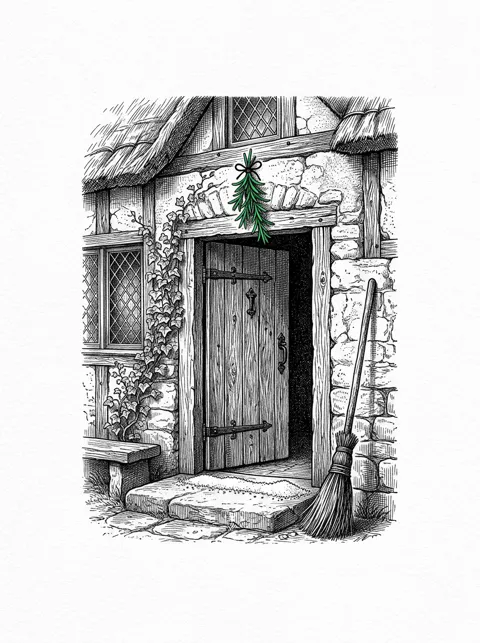
"Rosemary," Mrs. Hollin said, holding a sprig under Marisol's nose. It smelled like pine trees and Sunday dinner. "For remembering. People tuck it in books they want to keep, or lay it on graves, or hang it over the door so the house remembers who lives there."
3"Bay," she said the next day, and set a stiff, glossy leaf in Marisol's palm. "For wishes and for guarding. Write a wish on it, small, and keep it in your shoe or your pocket. A cook puts bay in the soup pot. A witch puts it in her shoe."
"Sage," she said on Thursday, and the leaves were soft and gray as a mouse's ear. "For clearing a room out. Some folks burn a bundle and carry the smoke through the house. I hang mine in the window and let the sun do the work. Fire wants watching, and I have a shop to run."
Marisol wrote it all down in a notebook with a marbled cover.
4Some herbs came with warnings.
"Mugwort," Mrs. Hollin said, and the leaves were green on top and silver underneath, as if they had two faces. "For dreams. You sew a little into a small pillow, and it's said your dreams come clearer. But you never eat it and you never brew it. It is not a kitchen herb, whatever the old books say."
"Chamomile," she said, and the dried flowers were tiny yellow buttons. "For calm, and for luck with money. Shopkeepers sprinkle it at the door so customers come in easy." She winked. "I sweep it across the step every Monday."
5"Lavender, for peace in a house and for sweet sleep. Tuck it in the drawer with the sheets." That one Marisol already knew.
Rue was last. Mrs. Hollin pulled on cotton gloves before she touched it. The leaves were blue green and shaped like tiny paddles, and the smell was bitter enough to make Marisol's eyes water.
"Rue is the old guardian," Mrs. Hollin said. "Herb of grace, they used to call it. A sprig over the door keeps trouble on the outside. But the sap can burn your skin when the sun hits it, so gloves, always. And never in your mouth. Not ever."
Marisol wrote NEVER in her notebook and underlined it twice.
6In October a woman came in asking for rosemary, and the rosemary drawer was empty. Mrs. Hollin was out back in the garden.
Marisol looked at the forty-second drawer. She looked at the back door. Then she knelt and pulled the worn brass leaf.
The drawer was full of rosemary. Fresh, too, the needles bright, the smell rushing up so strong it was like walking into a hillside. She scooped a handful into a paper bag for the woman. When she looked again, the drawer was just as full as before.
She shut it. She opened it. Full.
That night she lay awake thinking about it until the streetlight outside her window clicked off.
7After that, Marisol used the bottom drawer for everything.
When the bay ran low, she opened it and found bay. When a man wanted lavender for his new baby's room, there was lavender. She stopped refilling the labeled drawers from the jars in the storeroom. Why would she? She even took a fistful of sage home in her coat pocket, just because she could, and left it on her dresser, where it went brown and she forgot all about it.
Mrs. Hollin watched her. She did not say anything. She only looked, sometimes, at the bottom drawer, and then at the back door that led out to the garden.
8In November, Mrs. Hollin handed her the shears. "Cut what we need for winter," she said. "And leave the rest."
The garden was a narrow strip of dirt between the shop and the brick wall of the bakery next door. The rosemary bush was older than Marisol, thick as a barrel and taller than her head. She cut and cut. Her fingers were cold and she wanted to be done, and anyway, what did it matter? The drawer would always have more. When she finished, the bush was a stump of brown sticks.
Mrs. Hollin came out and stood looking at it for a long time. Her breath made small clouds.
"Oh, Marisol," was all she said.
9The next morning, Marisol opened the bottom drawer for rosemary and found three sprigs.
The next day, two.
She tried bay. A handful, then a few leaves, then one. She tried lavender and found only a dusty smell where lavender had been. It was as if the drawer were breathing out and could not breathe back in.
"It's broken," she told Mrs. Hollin. Her voice came out high and thin.
Mrs. Hollin sat down on the stool behind the counter. "It isn't broken. It was never bottomless. It has a garden for a bottom." She nodded at the back door. "Whatever we leave growing, it gives. Whatever we cut to the root, it can't."
10"Never take the last of anything," Mrs. Hollin said. "Not from a plant, not from a creek, not from a person who's being kind to you. Take a third and leave the rest to come back. My grandmother told me that, standing at this same cabinet."
"Why didn't you tell me?"
"I did. Leave the rest, I said." Mrs. Hollin almost smiled. "You weren't listening yet. Most of us aren't, the first time."
Marisol looked out the back window at the stump. It was snowing a little, wet flakes that melted the moment they touched the dirt. She thought about the brown sage on her dresser, wasted, and her stomach turned over.
11Two days before the solstice, an old man came in out of the snow. He had a wool cap pulled down over his ears and a gold ring that was too loose for his finger.
"Rosemary," he said. "My wife always put a sprig on the table for the longest night. She's gone this year. I'd like to do it for her."
Marisol knelt and opened the bottom drawer.
There was one sprig left. Just one, small and a little dry, lying in the corner like a lost key.
She held it. She thought of every handful she had scooped without looking. She thought of the stump in the snow. Never the last of anything.
12So she told him the truth. She told him about the shears and the stump, and that this was the very last sprig the shop had, and that she could not sell it.
She waited for him to be angry. Instead the old man laughed, a small surprised sound.
"My wife would have liked you," he said. "She never cut the last of anything either. Drove me crazy." He turned his cap in his hands. "Our daughter has a bush that started from a cutting of hers. I'll bring you a piece of it."
He came back on the morning of the solstice with a clay pot wrapped in a dish towel. Inside was a green cutting, rooted in damp soil.
13Marisol set the pot on the sill above the cabinet, where the light was best. Then she knelt, opened the bottom drawer, and broke the last sprig in two. The bigger piece she left in the corner. The smaller piece she wrapped in waxed paper for the old man, and this time it did not feel like taking.
All winter she watered the cutting. She raked straw over the stump. She refilled the labeled drawers from the storeroom jars, one by one, the slow way.
In April she planted the cutting by the brick wall. In May she opened the bottom drawer, and the smell of rosemary rose up to meet her, green and new, with something else under it she had never smelled before.
She took a little. She left the rest.
14The Real Practice Behind The Story
Each herb in this story carries a traditional meaning in folk practice. Rosemary stands for remembrance, bay for wishes and protection, sage for clearing a space, mugwort for dreams, chamomile for calm and good luck, lavender for peace, and rue for guarding a home. Many herbalists follow a simple harvest rule. Take no more than a third of a plant, and never the last of it, so it can grow back. Some of these plants are not safe to eat or drink. Rue can blister skin in sunlight, and mugwort and rue should never be swallowed. Ask an adult before handling any herb, wear gloves with rue, and keep dried herbs away from small children and pets.
15The End
Next on the shelf is The Card That Would Not Stay Shuffled.
Open The Next BookBack To The Shop16
Where Our Name Comes From
Salem, Massachusetts, where most of the town's witch shops sit on or near the Essex Street pedestrian mall. We are an online shop, not a storefront there.