Home / Storybooks / The Girl Who Bottled the Wind
The Girl Who Bottled the Wind
A Story Of Knot Magic
The Girl Who Bottled the Wind
A Story Of Knot Magic
A Salem Witch Shop storybook
1Maren Quill had sewn her first hem when she was six, and by twelve she could put eight stitches to the inch in heavy canvas without looking.
She hated it.
Her father's sail loft took up the whole top floor of a building on the north wharf. The floor was swept pine, wide enough to spread a mainsail flat, and the air smelled of beeswax and tar and the sea coming in through the big doors. Maren sat on a low bench there every afternoon with a leather palm strapped to her hand, pushing a long needle through canvas.
Outside, the boats went in and out. They went wherever the wind took them. Maren went from the bench to the stove and back.
2The only person in Thornby Harbor who seemed to understand this was Bettis Crane.
She was the oldest woman anyone knew, and she lived in a shingled shed at the very end of the wharf with a cat, a woodstove and a great many coils of rope. Maren brought her canvas scraps to burn. In return, Bettis told her things.
"When I was a girl," Bettis said once, "captains came to my grandmother's door with coins in their hands. They came to buy wind."
"You can't buy wind."
"You can if somebody's caught it first." Bettis held up a length of tarred cord, gray with age, with three fat knots spaced along it. "One knot for a breeze. Two for a good blow. And the third you never untie."
3Maren was back the next afternoon, and the one after that, until Bettis finally laughed and said she would show her, if only to get some peace.
"You need a cord you've laid yourself," Bettis said. "Three strands, twisted tight, hand over hand. And you need a wind worth catching."
It took Maren two weeks to lay the cord. She did it in the loft after her father went home, with twine from his own bins, twisting until her palms were raw. It came out lumpy but strong, about as long as her arm.
"Good," said Bettis, and pulled it between her fists until it creaked. "Now wait for weather."
Weather came in October, the way it always does on that coast.
4The northeaster blew in on a Tuesday night. By midnight the shutters on every house in Thornby were banging, and the harbor was white with spray.
Bettis took Maren to the end of the wharf. The wind was so loud they had to put their heads together to hear.
"Face into it," Bettis shouted. "Hold the cord up. When you feel it pull, tie."
Maren held the cord out over the black water. At first it only whipped and snapped. Then, between one gust and the next, it went stiff and heavy, as if something had grabbed the other end.
She tied the first knot. It hummed against her fingers like a plucked string.
She tied the second. Her teeth ached.
The third knot fought her. She had to pull it tight with her teeth.
5Afterward the cord was warm, the way a sleeping animal is warm, and the knots were as hard as walnuts. Bettis wrapped it in a square of sailcloth and pressed it into Maren's hands.
"First knot, a fair breeze," she said. "Second, a stiff wind. Third, you'd be letting loose the storm we just stood in, all of it at once. My grandmother said a man once untied the third to get home faster. They found his mast. They never found him."
Maren hid the cord in the toe of her winter boot under the bed.
Two weeks later her father signed on to the schooner Lettie Moss as sailmaker for the late trip out to the fishing banks. The loft had been slow all fall, and the trip paid well.
6The Lettie Moss went out with eleven other schooners on a bright cold morning. Maren stood on the wharf and watched her father's sails, which he had cut and sewn himself, turn small and white and then disappear.
The fleet was due back in ten days.
On the eleventh day there was no sign of them. On the twelfth, a mail boat came in from the south, and her captain said he had passed the whole fleet thirty miles out, sitting in water as flat as a plate. Not a breath of wind. Sails hanging like wash on a line.
"Dead calm," he said. "And their water casks are getting low by now, I'd guess."
That night the women of Thornby stood at the end of the wharf with lanterns and looked at the sea, which lay perfectly still.
7Maren went home and took the cord out of her boot.
She did not tell Bettis. She didn't tell anyone. She went back down to the wharf after the lanterns were gone, when the water was black and the stars lay in it without moving.
She faced the sea and picked at the first knot with her fingernails. It was tight, and the old tar made it slick. It took a long time. Then, all at once, it gave.
A breeze came out of the knot. She felt it on her face first, cool and smelling of rain, and then she heard it in the rigging of the boats tied at the wharf, a soft ticking of lines against masts.
It moved out over the water, ruffling the stars.
8In the morning the breeze was still blowing, gentle and steady, out to sea. But the fleet did not come.
All day Maren ran to the end of the wharf and back. All day the horizon stayed empty. A fair breeze was not enough to push twelve heavy schooners thirty miles. It would take days, and the water casks were low.
That evening she untied the second knot.
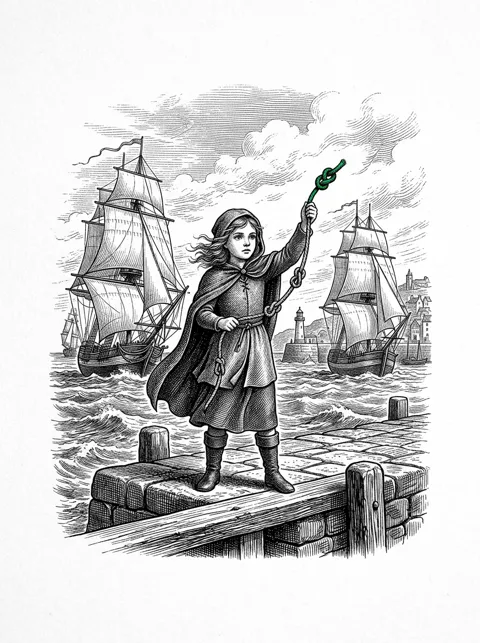
This one came loose hard, with a snap she felt in her wrists, and the wind that came out of it shoved her back two steps. It roared across the harbor, tearing the tops off the waves. Every boat at the wharf heeled over and groaned against its lines.
By morning there were sails on the horizon.
9There were twelve of them, small as white pins. The whole town came down to watch.
But by noon a fog rolled in off the water, thick and yellowish, and swallowed the sails one by one. Thornby Harbor had a reef at its mouth called the Teeth, and every child in town knew how many ships it had broken in a fog.
Maren stood at the end of the wharf with the cord in her fist. One knot left.
If the wind were stronger, she thought, it would blow the fog away. It would bring the fleet home before dark, past the Teeth. Her father's sails could take it. She knew how they were stitched. She had stitched some of them herself.
She heard Bettis say never.
She untied the third knot anyway.
10For one second nothing happened. The fog hung. The water lay flat.
Then the cord jumped in her hand like a caught fish, and the storm came out.
It was the northeaster, the whole October night of it, folded up and let go at once. It hit the wharf so hard the boards bucked under her feet. Shingles flew off the fish house. Somewhere behind her, the big doors of her father's loft tore open and slammed and tore open again.
Maren grabbed a piling and held on. Out at the harbor mouth the fog shredded into rags and blew away, and there was the fleet. It was close now, too close, every schooner heeled so far over that its rail was under water, racing straight for the Teeth.
11Someone was beside her. It was Bettis, in her nightgown and an oilskin coat, her white hair whipping across her face.
"What's untied can be tied again," she shouted into Maren's ear. "But it'll take all you've got."
She pushed the loose cord back into Maren's hands.
Maren held it up into the gale. This time the wind did not want to be caught. It pulled the cord so hard it burned her palms raw. She screamed, and the wind took the sound away. She wrapped the cord around her wrist and pulled back. Bettis wrapped her own old hands around Maren's, and together they dragged the knot closed a little at a time, like hauling in a net full of stones.
12The knot cinched shut with a sound like a door slamming far away.
The wind dropped. Not all of it. The northeaster was gone, folded back into the cord, but the stiff wind from the second knot still blew, and on it, one by one, the schooners came clear of the Teeth and into the harbor.
The Lettie Moss came last. Her mainsail had split from top to bottom and hung in two flapping halves. But her father was on deck, waving his hat, and Maren sat down on the wet boards of the wharf and couldn't get up again for a long time.
Her palms had a red stripe across them, twisted like rope. Bettis wrapped them in clean sailcloth and didn't scold her once.
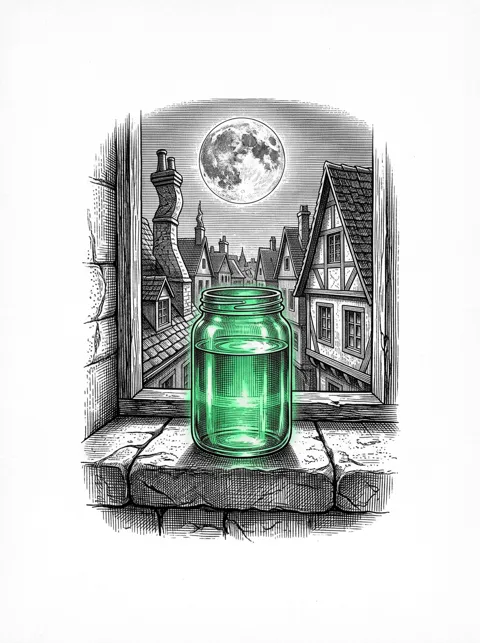
13The next day Bettis brought her a green glass bottle, the kind molasses came in, and a stub of sealing wax.
"Wind that's been let loose once never sits quiet," she said. "Best give it a house."
Maren coiled the cord inside, the first two knots gone slack and the third one tight and black and warm. She corked it, sealed it with wax, and set it on the high shelf in the loft, over the bench where she sewed.
That winter she and her father mended the split mainsail of the Lettie Moss together, eight stitches to the inch, his needle and hers meeting in the middle.
On stormy nights the bottle fogged on the inside. Maren never opened it. She sat under the shelf with her needle and listened to it hum.
14The Real Practice Behind The Story
Selling wind in a knotted cord is a real piece of sailors' lore. Old accounts from Scotland, the Isle of Man, Norway, Finland and the Baltic coast describe wise women who tied wind into a cord or a handkerchief with three knots and sold it to sailors before a voyage. Untying the first knot was said to bring a gentle breeze, the second a strong wind, and the third a gale. Knot magic itself is older still. Many traditions use tying to bind or hold something and untying to set it free. Thornby Harbor and its people are invented, but the charm of three knots and its warning about the last one are both very old.
15The End
Next on the shelf is The Lamp In The Window.
Open The Next BookBack To The Shop16
Where Our Name Comes From
Salem, Massachusetts, where most of the town's witch shops sit on or near the Essex Street pedestrian mall. We are an online shop, not a storefront there.