Home / Storybooks / The Moon Jar
The Moon Jar
A Story Of Moon Magic
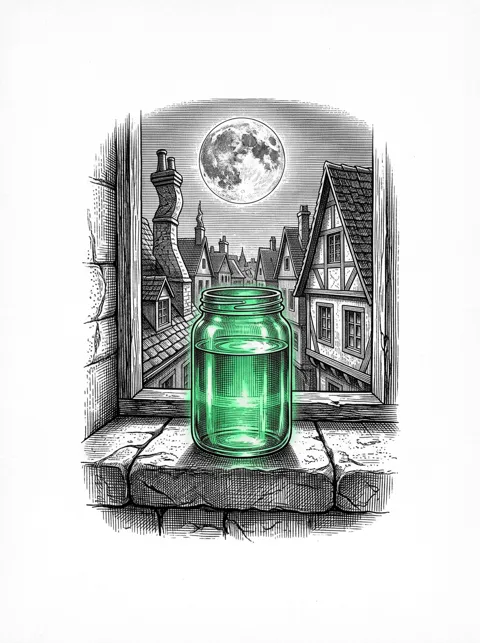
The Moon Jar
A Story Of Moon Magic
A Salem Witch Shop storybook
1The first jar was a pickle jar, and it still smelled faintly of dill when Gran rinsed it at the sink.
Wren watched from the kitchen doorway with her arms crossed. She had been living in her grandmother's narrow gray house above the harbor for nine days. Her suitcase was still packed under the bed upstairs, because unpacking it would mean she was staying.
"Tonight is the new moon," Gran said. She dried the jar with a dish towel printed with lobsters. "You can't see it. That's the point. It's the dark before anything starts."
"Before what starts?"
Gran held the jar up to the window. Her rings clicked against the glass. "Whatever you put in it."
2They filled it from the rain barrel by the back steps, because Gran said tap water was too tired to hold anything. Then Gran tore a strip from a paper grocery bag and handed Wren a pencil.
"Write one thing you want to begin. Not a thing you want to have. A thing you want to start."
Wren thought of her old room in the city, the crack in the ceiling shaped like a heron, her friend Priya two doors down. None of that was a beginning. It was all an ending.
She wrote, I want to start school without throwing up, and folded it small before Gran could see.
Gran didn't ask. She tucked the paper under the jar on the porch rail and set a saucer over the top to keep the moths out.
3The night was very black. The harbor lights were the only lights, and they shook on the water like loose buttons.
"Shouldn't it go where the moon is?" Wren asked.
"The moon is right there," Gran said, pointing at nothing. "She's just facing the other way. Some nights you work by what you can't see."
Wren went to bed with the window open. She could hear the bell buoy out past the breakwater, low and slow, like something breathing in its sleep.
In the morning the jar was cold and beaded on the outside. The paper underneath was damp. When Wren unfolded it, the pencil had smeared, but she could still read the word start.
She went to school. She did not throw up. It was not a good day, but it was a day.
4Over the next week the moon came back a sliver at a time. It hung over the cannery roof like a fingernail clipping, then like a slice of lemon in a glass.
Gran kept the jar on the porch through all of it. "Waxing," she said. "Growing. Whatever you started, you feed it now."
So Wren fed it. She ate lunch at the end of a table beside a quiet boy named Arlo Fenn, who drew boats in the margins of his worksheets. On Thursday she said one sentence to him. On Friday he said two back.
Each night she stood at the porch rail and looked into the jar. The water was dark. But on the night of the half moon, she was sure she saw a thread of light in it that was not coming from the sky.
5The full moon came on a Sunday.
Gran washed a clean mason jar and filled it fresh from the rain barrel. She set out the rest of her things on the porch table. A little dish of salt. A white candle stub. A sprig of mugwort from the side yard, gray and soft as a mouse.
"Full moon is for charging," she said. "The water sits out all night and takes up the light. Then it's strong. You wash your hands in it before a hard thing. You water a sick plant with it. You wipe it on a doorknob when you want a door to open for you."
"Do you drink it?"
"Not this. It sits outside all night with moths and leaf bits and who knows what. It's for the outside of you."
6The moon rose huge and orange out of the sea, then shrank and whitened as it climbed. By the time Gran went to bed, it had laid a bright road across the harbor straight to the porch steps.
Wren did not go to bed.
She had a second jar hidden behind the woodpile. It was a peanut butter jar she had scrubbed out herself. Under it was a letter she had written that afternoon and never mailed. It was to her mother, who was still in the city with the apartment and the heron crack and all the things Wren hadn't been allowed to choose.
The letter said, Let me come home. Make it like it was.
Wren set her jar beside Gran's jar, right in the white road of the moon, and held her breath.
7For a while nothing happened. The candle stub guttered. A moth bumped against Gran's jar and slid off.
Then Wren noticed the sound.
It was very small, a thin ringing, the way a glass sings when you run a wet finger around the rim. It came from her jar. The water inside had gone bright, much brighter than Gran's, as if it were pulling the moonlight toward itself and not letting any go.
The porch boards were cold under her bare feet. The bell buoy had stopped. Even the harbor had gone flat and quiet, the moon road lying across it like a sheet of tin.
Wren leaned in. In the water she could see the moon, and her own face, and behind her own face, very clearly, the heron crack in her old ceiling.
8She reached for the jar, and the glass was so cold it stung.
Wren snatched her hand back. The ringing grew higher. Down the hill a dog began to bark, then another, and in the house behind her a light snapped on.
Gran came out in her bathrobe with her hair in a long gray braid. She looked at the two jars. She looked at the paper under the peanut butter jar, and she didn't have to read it.
"Oh, honey," she said. "You can't charge a going back."
"Why not?"
"Because the moon doesn't go back. She goes around." Gran wrapped the dish towel around her hand and lifted the jar. The water inside tipped slowly, too heavy, like it was thicker than water should be. "Look at it. It's trying to hold the whole night still."
9They sat on the steps together with the cold jar between them on the towel. Wren's palm had a red ring on it where the glass had touched.
"I don't want to be here," Wren said. It came out louder than she meant it to.
"I know."
"I want my room. I want Priya. I want Mom and Dad at the same table."
Gran didn't say any of the things grownups usually said. She didn't say Wren would make new friends, or that the gray house would feel like home soon. She only nodded, slowly, the way she nodded when the radio read out the tide tables.
"Then keep it," she said. "Keep it until the moon starts getting smaller. That's when this kind of water is for."
10So the peanut butter jar went on the windowsill of Wren's room, with the letter still folded under it.
It stopped ringing after the first night. But it stayed cold. Every morning there was frost on the inside of the glass, even though it was only September and the radiators clanked and hissed all night.
The moon began to shrink. First it lost a little from one side, as if someone had taken a bite. Then it was a half again, but the other half this time, rising later and later, until Wren only saw it on the way to the school bus, pale over the water tower.
"Waning," Gran said one morning over oatmeal. "That's the letting go part. You take what you don't want to carry anymore, and you give it back."
11On the night of the last thin crescent, Gran and Wren carried the jar down the hill to the rocks below the seawall. The tide was going out. It made a long sighing sound through the stones.
"Out with the tide, out with the moon," Gran said. "That's how my mother did it. You pour it where it can leave."
Wren unscrewed the lid. Her fingers ached with the cold of it. She thought about the heron crack and the radiator in her old room that hissed like a cat. She thought about Priya's porch light, and about the sound of two voices in a kitchen getting quieter and farther apart.
She didn't want to pour it.
She tipped the jar anyway.
12The water came out bright. For one second it lay on top of the dark harbor like spilled milk, a small moon that didn't belong to the sky. Then the tide took it. It slid out between the rocks, thinner and thinner, and was gone.
The jar in Wren's hands was only a jar. It was warm. It smelled like peanut butter.
She tore the letter into pieces and let the wind take those too. Some of them fell in the water. Some blew back against her coat and stuck there, wet, and she had to peel them off one at a time.
"It doesn't all go at once," Gran said. "That's all right."
Wren cried then, a little, and Gran let her, and the bell buoy rang out past the breakwater.
13Two nights later there was no moon at all.
Wren found the pickle jar in the cupboard, the one that still smelled faintly of dill. She filled it at the rain barrel without being asked. She tore a strip off a grocery bag.
Gran watched from the doorway with a mug of tea, the way Wren had watched her a month before.
Wren thought for a long time. Arlo Fenn had asked her on Friday if she wanted to see his uncle's boat. She hadn't answered yet. She wrote, I want to say yes, and under that, I want to start unpacking. She set the paper under the jar on the porch rail and put the saucer on top to keep the moths out.
Upstairs, she pulled the suitcase out from under the bed and opened it.
14The Real Practice Behind The Story
Moon water is a modern name for an old habit. Many folk traditions treat moonlight as something water can take up, so people leave a jar of water outside or on a windowsill overnight, most often at the full moon. Afterward it is used to water plants, rinse hands, or wipe a doorway or a table set aside for that purpose. Many practitioners match the work to the phase. The new moon is for beginnings, the waxing moon for growth, the full moon for charging, and the waning moon for letting go. Water left outdoors overnight collects dust, insects and germs, so moon water is for outside use only and never for drinking.
15The End
Next on the shelf is The Broom That Swept Backward.
Open The Next BookBack To The Shop16
Where Our Name Comes From
Salem, Massachusetts, where most of the town's witch shops sit on or near the Essex Street pedestrian mall. We are an online shop, not a storefront there.